


How Executive Leadership Shapes Sales Performance
AI Summary
Executive leadership has a measurable influence on sales performance, whether organizations recognize it or not. Across thousands of sales evaluations and organizational assessments, patterns consistently emerge around accountability, coaching, morale, and leadership communication. Sales teams tend to mirror the environment created around them. Organizations with strong executive alignment, consistent accountability, development-focused coaching, and healthy cross-functional collaboration often create stronger sales cultures and more consistent execution. Conversely, leadership inconsistency, reactive communication, weak coaching environments, and organizational friction frequently surface later in pipeline quality, seller confidence, and revenue performance. The data suggests that improving sales performance often requires looking beyond frontline selling skills alone and examining the broader leadership culture shaping the sales organization.¹
Sales performance is often measured through revenue attainment, pipeline growth, conversion rates, and forecasting accuracy. Yet behind many of those outcomes is a less visible factor that influences them all: executive leadership. Across thousands of sales evaluations and organizational assessments, a consistent pattern emerges. Leadership behavior shapes the environment sales teams operate within, and that environment directly impacts performance.¹
Many organizations invest heavily in sales training, enablement tools, compensation plans, and process optimization. Those initiatives matter. However, sales performance rarely improves sustainably when accountability, coaching, communication, and organizational alignment are inconsistent at the leadership level.
The highest-performing sales organizations tend to treat revenue growth as a company-wide responsibility rather than a challenge owned solely by the sales department.¹
Sales Performance Reflects Leadership Culture
Executive leadership influences sales performance in ways many organizations underestimate.
Sales teams respond to the culture surrounding them. Leadership decisions affect:
- Accountability standards
- Coaching expectations
- Internal collaboration
- Strategic clarity
- Team morale
- Decision-making speed
- Confidence in leadership
- Cross-functional alignment
Research from McKinsey & Company found that high-performing B2B organizations create stronger alignment between executive leadership, operations, and commercial execution than lower-performing peers.²
When leadership teams operate with consistency and accountability, sales organizations often mirror those behaviors. When priorities constantly shift, accountability becomes selective, or communication creates uncertainty, those effects eventually appear in pipeline quality, forecasting accuracy, morale, and execution.
Sales culture is rarely isolated from executive culture.
Accountability Begins at the Executive Level
One of the strongest patterns observed across sales organizations is the relationship between accountability and performance.¹
Within OMG’s data, salespeople who improve their Responsibility scores are more likely to improve tactical selling competencies.¹
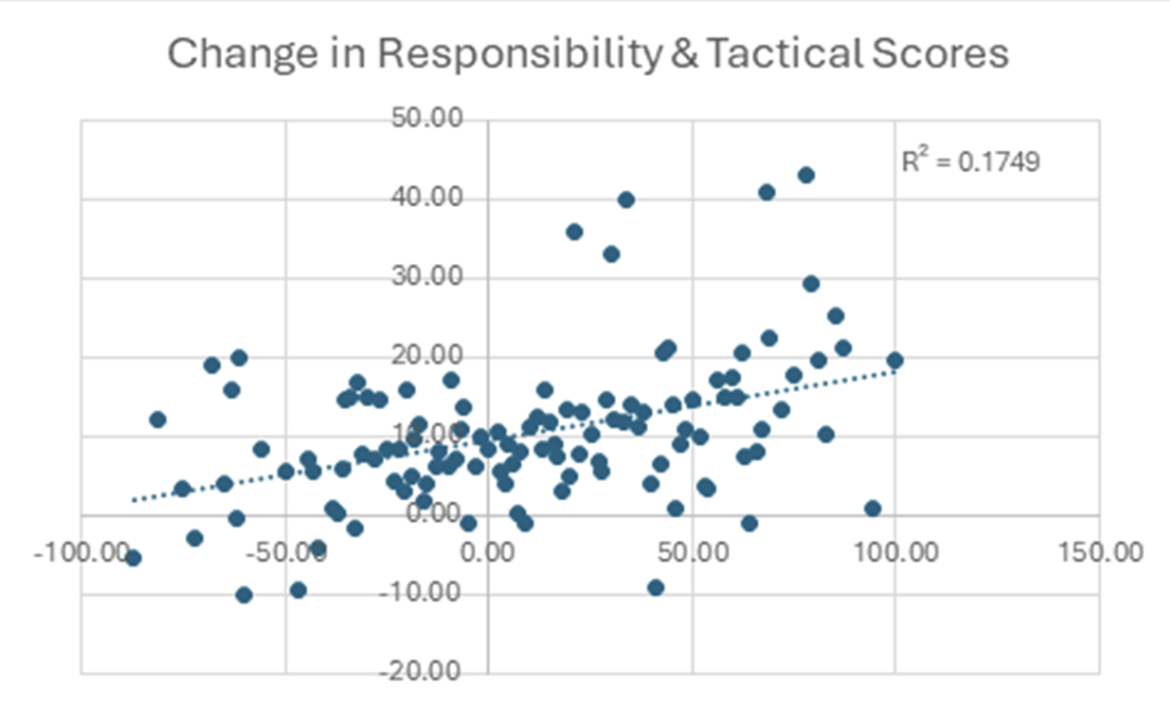
Responsibility inside a sales force is heavily influenced by leadership behavior.
Strong accountability cultures typically include leaders who:
- Take ownership when business decisions create obstacles
- Set clear expectations
- Address issues directly
- Focus teams on controllable actions
- Reinforce execution standards consistently
This matters because salespeople often internalize the behavior modeled around them.
Organizations where leadership frequently redirects blame toward market conditions, product limitations, or external factors often create sales cultures where excuses become normalized. Conversely, organizations where leaders openly acknowledge operational gaps or strategic mistakes tend to create stronger ownership within frontline teams.
Research published by Harvard Business Review has similarly highlighted how leadership transparency and psychological safety improve organizational accountability, collaboration, and performance.³
Coaching Quality Often Matters More Than Coaching Volume
Many organizations believe they are coaching consistently when, in reality, most manager conversations revolve around forecasting, pricing, product support, or pipeline updates.
Development-focused coaching is different.
OMG’s research has shown that salespeople who receive daily coaching are approximately 10 times more likely to master competencies than those coached quarterly.¹
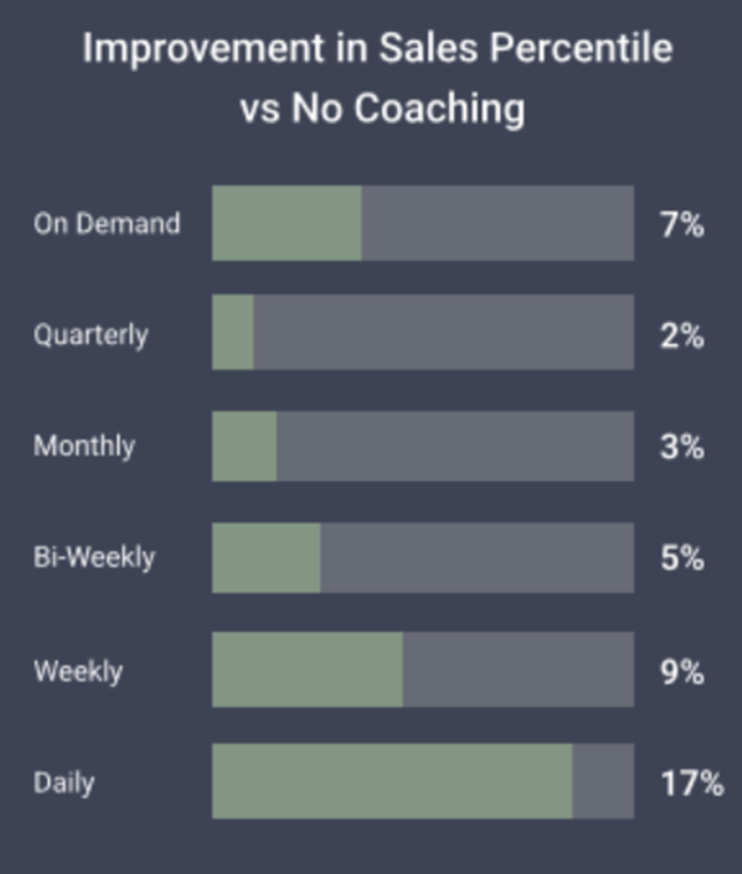
Frequency matters. Quality matters just as much.
The most effective coaching environments focus on:
- Skill development
- Questioning strategies
- Buyer psychology
- Sales execution
- Reflection and self-assessment
- Behavioral reinforcement
Organizations with strong executive alignment around development tend to create healthier coaching cultures overall. Leadership teams that protect coaching time and reinforce development priorities make it easier for managers to focus on long-term skill improvement rather than operating exclusively in reactive mode.
The strongest coaching environments are also often cross-functional.
When finance, operations, product, or executive leadership teams actively help salespeople better understand customer business impact, sellers become more effective in executive-level conversations. This type of organizational support strengthens value-based selling and improves alignment between departments that often operate independently.
Leadership Directly Influences Sales Outlook
Outlook is one of the more overlooked drivers of sales performance.
In OMG’s evaluations, Outlook measures how salespeople feel about:
- Their company
- Leadership
- Their role
- Their environment
- Their future opportunity
Salespeople who improve their Outlook are somewhat more likely to improve sales performance overall.¹
The relationship may appear moderate in isolation, but Outlook affects multiple areas of selling behavior simultaneously.
Sales conversations are emotional exchanges. Confidence, conviction, enthusiasm, and certainty influence buyers long before purchasing decisions are rationalized logically.
Leadership behavior plays a major role in shaping those emotional dynamics internally.
Executive visibility, communication consistency, recognition, responsiveness, and organizational trust all contribute to seller confidence. Small leadership interactions often have larger downstream effects than many executives realize.
Outlook is also one of the more volatile competencies measured within OMG’s data.¹ That volatility makes leadership influence particularly significant during periods of organizational change, uncertainty, or pressure.
Gallup research has consistently shown that leadership and management behavior strongly influence employee engagement, discretionary effort, and workplace motivation.⁴
In sales organizations, those effects frequently surface in pipeline consistency, prospect engagement quality, and resilience under pressure.
Effective Selling Often Looks Uncomfortable
Another area where executive leadership can unintentionally impact sales performance is through misunderstanding what strong consultative selling actually looks like.
Many leaders outside of sales perceive successful selling as primarily relationship-driven: maintaining rapport, entertaining prospects, and preserving likability.
Complex B2B selling is often much more challenging than that.
High-performing salespeople frequently need to:
- Ask difficult questions
- Challenge buyer assumptions
- Push beyond surface-level problems
- Create urgency
- Discuss financial impact directly
- Disrupt buyer inertia
Those conversations can feel uncomfortable to observe, especially for executives without direct sales experience.
But avoiding tension often weakens sales effectiveness.
Organizations that encourage overly cautious conversations or prioritize approval over honest business dialogue frequently limit their sellers’ ability to uncover real business problems and create urgency.
Strong consultative selling requires confidence, emotional resilience, and the willingness to challenge buyer thinking when necessary.
Executive leadership influences whether those behaviors are reinforced or unintentionally discouraged across the organization.
Leadership Sets the Ceiling for Sales Performance
Across accountability, coaching, outlook, and consultative selling behaviors, a consistent theme appears repeatedly: leadership culture shapes sales culture.¹
Sales organizations rarely outperform the environment surrounding them for extended periods of time.
That does not mean executives need to become sales experts. It does mean leadership teams benefit from understanding how their communication, expectations, operational decisions, and cultural behaviors directly influence commercial performance.
The organizations that sustain growth most effectively typically approach sales performance as an organizational system rather than an isolated departmental function.
Key Takeaways for Executive Teams
Based on OMG’s findings and organizational leadership observations, executive teams should consider the following:
- Accountability begins with leadership behavior
- Coaching quality matters just as much as coaching frequency
- Leadership communication directly impacts seller confidence and morale
- Effective consultative selling often requires discomfort and tension
- Cross-functional support strengthens sales execution significantly
- Sales culture usually reflects executive culture over time
Organizations looking to improve sales performance may need to evaluate leadership alignment and organizational behaviors just as closely as they evaluate pipeline metrics or sales process execution.
References
- Objective Management Group. (2025). How executive leadership impacts sales performance [Presentation materials].
- McKinsey & Company. (2024). The new B2B growth equation. Retrieved from McKinsey & Company
- Clark, T. (2023). What is psychological safety? Harvard Business Review. Retrieved from Harvard Business Review
- Gallup. (2024). Employee engagement drives growth. Retrieved from Gallup